

How to Value an Irish SME: A Guide to Business Valuation Methods


“What’s my business actually worth?” This is a question asked at various stages of the business ownership cycle. In other words, it’s not just a question to answer when putting a business up for sale.
Business valuation is the process of estimating what a company is worth at a given point in time. The valuation is typically aligned with a specific purpose. For example, a sale, share transfer, tax filing, or dispute. For Irish SMEs, the estimate almost always comes down to the maintainable earnings of the business and its assets, or how similar businesses have recently changed hands.
It’s worth noting that there is no single or correct number when valuing a business. Instead, it is a range shaped by the specific facts, purpose, and professional judgement applied in each case.
In this blog, we are focusing on Irish SME valuations, as there are differences compared to valuing businesses in, for example, the UK or the US.
We’ll look at the main business valuation methods, how they are applied to Irish businesses, and the tax angles that can impact the valuation. We’ll also work through a practical example.
It’s also worth noting that this article is presented as general guidance. It is not a substitute for advice on specific circumstances. Also, Gilroy Gannon’s approach in all cases is to assess the specific circumstances of the business valuation at the time.
Table of Contents
- Understanding Why You Need a Business Valuation
- The Three Core Valuation Methods Used for Irish SMEs
- Earnings-Based Business Valuations
- What Moves a Business Valuation Multiple
- Asset-Based Business Valuations
- Market-Based Business Valuations
- A Worked Example: Valuing a €1.2m Turnover Irish Services Business
- Irish Tax Considerations That Affect Valuation
- Common Mistakes that Reduce or Inflate the Value of Irish SMEs
- Getting a Professional Valuation
Understanding Why You Need a Business Valuation
There is no fixed formula for valuing an Irish SME. The right approach in each circumstance comes down to a range of factors. Examples of those factors include the nature of the business, the professional judgement applied, and the purpose of the valuation. No two valuations, even for the same company, necessarily follow the same path. The path followed, and the figures produced, reflect the different facts, assumptions, and judgements in each case.
Common reasons for valuing a business include:
- Preparing to sell
- Bringing in a new investor
- Implementing a share option scheme
- Succession planning
- Divorce
- Shareholder disputes
- Probate
A business valuation is also beneficial if you want to understand whether you are building wealth or just generating income.
In terms of which valuation method is correct, there is no fixed rule. Instead, method selection is on a case-by-case basis.
Appealing to the Audience
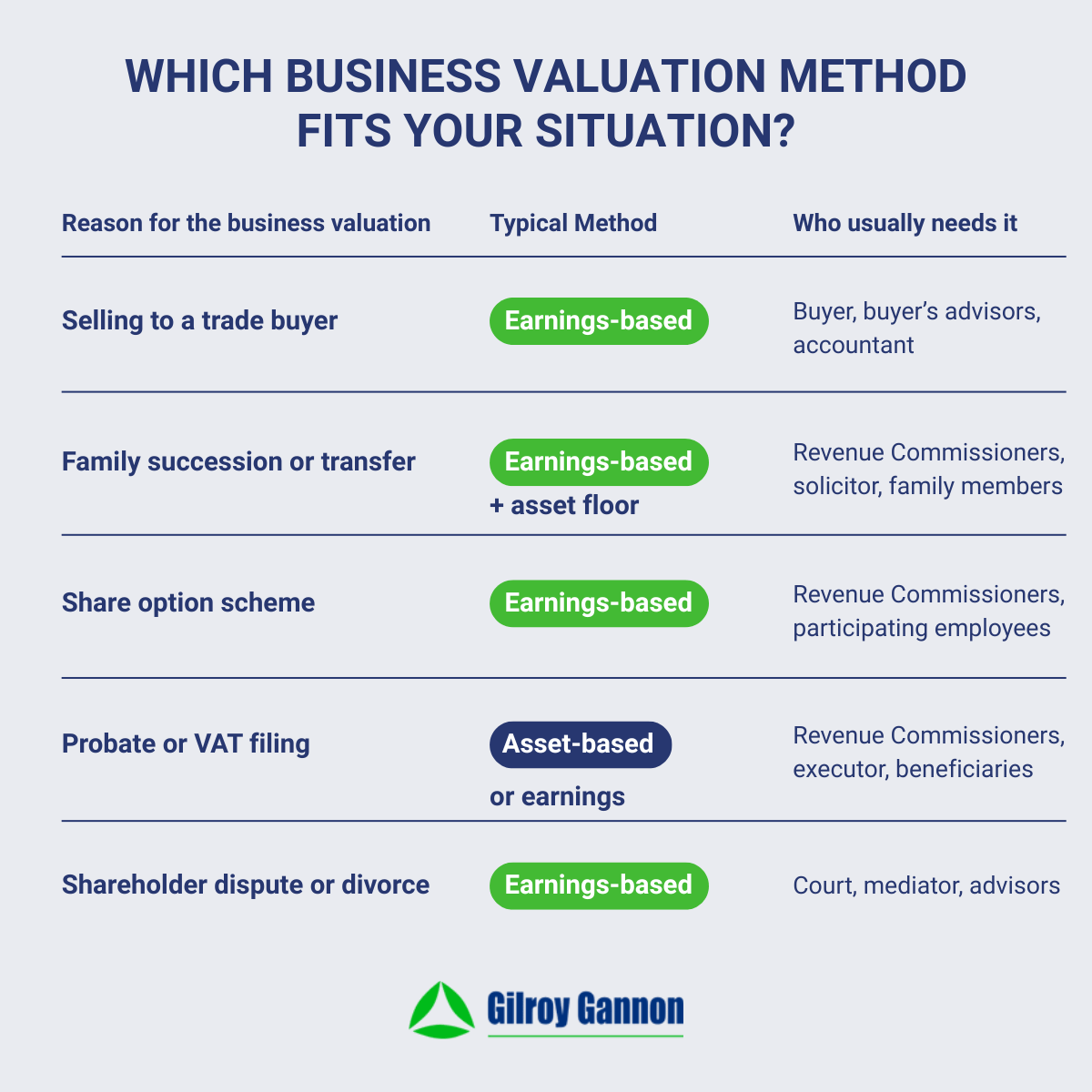
Different methods for valuing a business are needed because target audiences assess valuations differently. Here are some examples:
- A potential buyer of the business wants accurate, data-backed earnings.
- The Revenue wants a methodology that aligns with CAT or CGT rules.
- A court wants independence and accurate evidence.
This means the same business can have different valuations at the same point in time, depending on the purpose. For example, a business valuation for a family share transfer is not the same as a business valuation for a trade buyer. The specific approach and figures used must always be assessed on a case-by-case basis.
Furthermore, the business itself can influence the method used for the valuation. This includes the sector the business operates in, its assets, the stability of its earnings, etc.
In summary, the appropriate approach to value a business depends on the specific facts and circumstances of each case as assessed at the time by a qualified advisor.
The Three Core Valuation Methods Used for Irish SMEs
There are three broad approaches to valuing a business in Ireland: earnings-based, market-based, and asset-based.
Earnings-Based Business Valuations
The earnings-based business valuation method values a company based on what it can sustainably generate. It answers the question: “What can this business reliably generate in revenues and profit?”
Market-Based Business Valuations
The market-based business valuation method values a company against the recent sales prices of comparable businesses. It answers the question: “What have similar businesses sold for?”
Asset-Based Business Valuations
The asset-based business valuation method values a company on what it owns minus what it owes. It answers the question: “What is left in the business if you stripped it down to its parts?”
Business Valuation Method Comparison
The table below compares earnings-based, market-based, and asset-based business valuation methods.
| Earnings-Based | Market-Based | Asset-Based | |
|---|---|---|---|
| Measures | What a business can sustainably generate | What comparable businesses have sold for | What’s owned minus what’s owed |
| Best fit | Owner-managed trading businesses | Sectors with genuine comparable data | Asset-heavy or weak-trading businesses |
| Formula | Maintainable EBITDA x multiple | Comparable multiple x revenue/EBITDA | Fair value of assets – liabilities |
| Pros | Reflects real earning power, most widely used and understood | Grounded in real transactions, useful cross check | Simple and easily defended floor value, less dependent on judgement |
| Cons | Requires careful normalisation, multiple choice is judgement-based | Private comparable Irish data is rarely available | Ignores earning potential, book values are often stale |
It’s important to note that there is no fixed correct method to use. Method choice is a matter of professional, case-by-case judgement.
Using Business Valuation Methods in Practice
There are several practical points to highlight in relation to the main business valuation methods:
- Most Irish SME valuations focus on one of the above methods as the primary approach while using a second method to sanity-check the result.
- The asset-based method is often used to establish a floor value of the business alongside a higher earnings-based figure.
- As mentioned previously, the business valuation method used can depend on the type of business. For example, the earnings-based method is suitable for most owner-managed businesses. Asset-based suits asset-heavy or weak-trading businesses, while market-based can be used where comparable data exists.
One final point to highlight is the limitations that exist specifically in Ireland, particularly in relation to market-based business valuations. This is because comparable transaction data for private SMEs is both minimal and rarely publicly available. While asset-based is a genuine business valuation method, the reality is it is used much more cautiously in Ireland than textbook examples or explanations written from a US or UK perspective.
Of the three methods available, earnings-based is the most commonly used to value Irish SMEs.
Earnings-Based Business Valuations
Earnings-based business valuations focus on what a business can sustainably generate. The calculation is typically: maintainable EBITDA multiplied by a figure reflecting the company’s risk and growth prospects.
Each element of that calculation is worth further explanation:
- EBITDA (earnings before interest, tax, depreciation and amortisation)
- Maintainable means adjusting reported profit to properly reflect what the business would earn under normal and ongoing conditions. In other words, it doesn’t look at what happened in a particular year.
- For the multiple (2x, 7x, etc), the lower the perceived risk of earnings continuing (and growing), the higher the multiple that can be applied.
There are good reasons why this is the default business valuation method for most owner-managed Irish SMEs. Unlike a property or a piece of machinery, the value of a trading business rests mainly in its ability to keep generating profit after a sale. In other words, a buyer isn’t paying for last year’s results and set of accounts. They are instead paying for what they expect the business to produce in the future.
EBITDA is the usual starting point rather than net profit. This is because it strips out elements that can differ from business to business. For example, two companies with identical trading performance can report very different net profit figures depending on how they are financed or how they depreciate their assets. EBITDA levels this playing field.
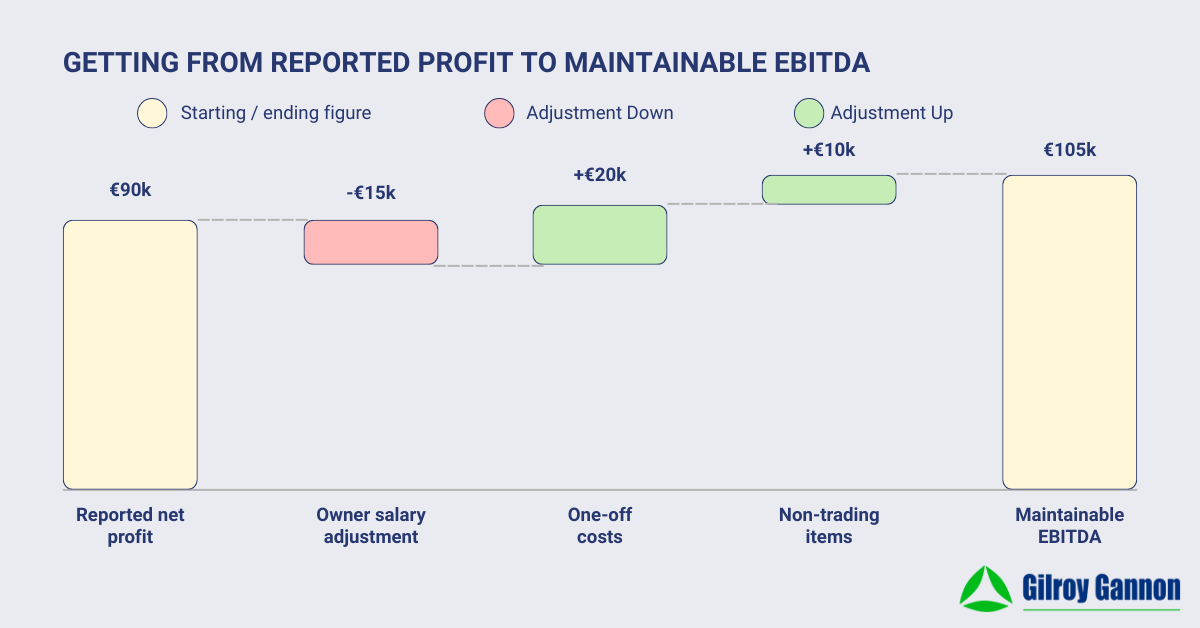
Getting from reported profit to maintainable EBITDA means correcting for anything that distorts the true trading picture.
Owner salary is usually the biggest adjustment. It is also the one that many Irish business owners get wrong when they are trying to estimate the value of their company. This is because many owners pay themselves well below the market rate for the job they do, inflating reported profits. Other owners take a higher salary than the market rate. This could be for tax or personal reasons, but the result is understated business profits.
Either way, the owner’s salary figure needs to be adjusted to reflect what the role would genuinely cost the business to fill.
From Reported Profit to Maintainable EBITDA
Other Adjustments to Maintainable Earnings
One-off and non-trading costs need the same treatment. Examples of one-off and non-trading costs include legal settlements, bad debt write-offs, grants that won’t recur, or a family member on the payroll who won’t be staying on.
One-off and non-trading costs like these need to be added back or stripped out as they don’t reflect how the business will perform in the future.
It is worth highlighting that this isn’t only a cost exercise. The revenue side needs the same treatment. Things like a contract coming to an end, a key customer at risk, or income tied to a founder’s personal relationships might trigger adjustments to properly reflect future business performance.
The key point to remember is that a valuation built on earnings that won’t repeat in future years is not a maintainable valuation, regardless of whether the figures add up.
What Moves a Business Valuation Multiple
Despite common perceptions, a business valuation multiple isn’t fixed by company sector. Instead, it moves up or down based on the riskiness and predictability of the company’s future earnings, often as judged by the potential buyer. For example, the less a business depends on its current owner or the more recurring its revenue, the higher the multiple that can be applied.
The key factors that move a business valuation multiple up or down include:
- Owner dependency
- Customer concentration
- Revenue quality and recurrence
- Sector and growth trajectory
- Quality of financial records
- Management depth
Owner Dependency
For Irish SMEs, owner dependency is often the biggest factor influencing the business valuation multiple. If a business will struggle to operate as before without the current owner, buyers will price in that risk through the multiple.
Examples of owner dependency include client relationships, technical knowledge, and supplier relationships.
Reducing owner dependency can, therefore, increase the business valuation multiplier and, by extension, the value of the business. Examples of how to reduce owner dependency include:
- Documenting processes
- Developing a robust management layer that runs the business
- Developing client relationships that don’t rely completely on the business owner
Customer Concentration
A business that relies heavily on a couple of clients for the majority of its revenue is much riskier than a business with a broad customer base. Therefore, it is likely to have a lower business valuation multiplier.
Revenue Quality and Recurrence
Not all revenue is treated the same when it comes to business valuation multipliers. Specifically, recurring or contracted revenue will be valued more than one-off projects or transactional revenue. This is because recurring or contracted revenue (such as retainers, maintenance contracts, and subscriptions) is more predictable.
Sector and Growth Trajectory
There are some sectors that command higher business valuation multiples. For example, a technology or IP-driven business will likely have a higher business valuation multiple than a commoditised service business, all else being equal.
Similarly, companies in growing markets will also command higher business valuation multiples than those in flat or declining markets.
Quality of Financial Records
This point is all about perceived risk. When financial records are clean, complete, well-organised, and audited, perceived risks are reduced, and business valuation multiples can be potentially increased.
The reverse is also true, i.e., messy or informal financial records mean buyers will price in uncertainty, lowering the business valuation multiple that can be used.
Management Depth
This point is connected to owner dependency and is all about the ability of the business to continue as before without its current owner. A strong and capable tier of management below the owner facilitates this continuity. This can positively influence the business valuation multiple.
Business Valuation Multiple: Practical Points to Highlight
The first point worth highlighting is that the factors above influence the business valuation multiple, not the maintainable earnings figure. Here’s a reminder of the equation again:
- Business valuation = maintainable EBITDA x business valuation multiple (2x, 7x, etc)
The final point to highlight is that all the factors above are within a business owner’s control, especially when looked at over several years. In other words, they can all be addressed in a way that positively impacts the multiple used when the business is being valued.
Asset-Based Business Valuations
Asset-based business valuations focus on what a company owns minus what it owes. The method uses the current market value of assets rather than their value on the company’s balance sheet. It’s an approach to business valuations best suited to asset-heavy businesses. It is also often used as a floor value beneath an earnings-based figure rather than as the primary method on its own.
Other situations where asset-based business valuations can apply include companies with a weak or inconsistent trading history, as well as companies being wound down or sold for parts rather than as a going concern.
Assets that count in an asset-based business valuation include tangible assets (property, equipment, stock, cash, etc) and intangible assets (patents, trademarks, copyrights, etc). Goodwill is typically excluded.
The formula is typically:
- Net asset value = fair value of assets minus liabilities
Market-Based Business Valuations
Market-based business valuations reference what genuinely comparable businesses have recently sold for, expressed as a multiple of revenue or earnings. For private Irish SMEs, the reality is that usable comparable data is often limited. As a result, this method typically supports an earnings-based valuation rather than being used as the primary approach.
When looking at whether a business sale is comparable, examples of the factors that are considered include sector, business size, and business growth profile.
A Worked Example: Valuing a €1.2m Turnover Irish Services Business
Here’s a simplified business valuation illustration using a facilities management company as the example. For this example, we’ve used the following:
- 12 years trading
- One owner-director
- 14 staff
- Turnover of €1.2 million
It’s important to stress the figures below are illustrative. A real-world business valuation depends on the specifics of the company.
That said, the process outlined below is representative of how an earnings-based valuation is achieved.
Reported Profit as the Starting Point
The business’s most recent accounts in our illustrative example show a net profit before tax of €120,000. This is after depreciation of €15,000 and loan interest of €5,000. Adding these back gives an unadjusted EBITDA of €140,000.
This is the figure most owners quote when asked what their business makes. However, it is not yet a maintainable EBITDA. A maintainable EBITDA is what we need to achieve for the business valuation.
Adjusting to Achieve a Maintainable EBITDA
| Adjustment | Effect |
|---|---|
| Unadjusted EBITDA | €140,000 |
| Owner salary normalisation (the owner draws €50,000 a year, but the market rate for a general manager in a similar role is €80,000) | -€30,000 |
| One-off legal settlement (non-recurring) | +€20,000 |
| Grant income received this year only (non-recurring) | -€10,000 |
| Spouse’s salary with the role not required post-sale | +€15,000 |
| Maintainable EBITDA | €135,000 |
The owner’s salary adjustment is the biggest single adjustment. It also cuts differently from what most owners expect.
Because the owner is currently underpaying herself relative to the market rate for the role she is performing, the true ongoing cost base is higher than appears in the company’s accounts. As a result, the maintainable EBITDA figure moves down, not up, with the owner salary adjustment.
Choosing the Multiple
This business has a moderate level of customer concentration – its largest client accounts for around 18% of revenue. The business is also in a stable but not fast-growing sector, and it has reasonably good management depth below the owner.
That profile of the business puts it in a mid-range multiple bracket rather than at the top or bottom of the scale. For this illustrative example, we are using a range of 3x to 4x maintainable EBITDA.
- 3 x maintainable EBITDA is €135,000 × 3 = €405,000
- 4 x maintainable EBITDA is €135,000 × 4 = €540,000
Adding Net Assets
Our example business also holds €50,000 in cash that is surplus to its working capital needs. As this is cash that is not required to run the business day to day, it would typically be added on top of the earnings-based figure rather than absorbed into it.
The Resulting Range
Combining the earnings-based range with the cash surplus gives a valuation for this business of roughly €455,000 to €590,000. The exact value depends on where the agreed multiple eventually lands within the 3x to 4x range.
€455,000 to €590,000 for a business valuation is a genuinely wide range from the same set of accounts. It reflects the fact that a business valuation is not a single calculation with one right answer. Instead, it’s a range shaped by judgement calls on maintainable earnings and risk. This is why two advisers can look at the same accounts and land on different figures without either being wrong.
Irish Tax Considerations That Affect Valuation
A business valuation doesn’t exist in a vacuum. How the number is calculated, and how it can be defended, has direct tax consequences depending on why it’s being prepared. This is where advice from an accountant becomes even more important.
Selling the Business
Selling a business typically triggers Capital Gains Tax (CGT). Getting the valuation right isn’t just about agreeing on a sale price with a buyer. It directly determines the size of the taxable gain, and therefore the CGT due.
Passing the Business to Family
Transferring a business to family can qualify for Retirement Relief, but only where the valuation used to test the relief’s limits is acceptable to the Revenue Commissioners. Undervalue the business and the relief itself can be challenged. Overvalue the business, on the other hand, and you risk restricting how much can be transferred within the threshold.
It’s important to note that the relevant relief and figures depend on the specific facts of each case. Therefore, professional advice should always be taken before relying on any valuation for this purpose.
Gifting or Inheriting Shares
Where shares are gifted or inherited, it’s the recipient who is taxed. The amount of tax that is due is based on the value of what they receive above their tax-free Capital Acquisitions Tax (CAT) threshold. Business Relief can significantly reduce that taxable value, but only against a valuation that holds up to scrutiny.
As in the previous point, the specific facts should be assessed on a case-by-case basis by a qualified professional.
The Revenue Commissioner’s Expectation of Business Valuations
Across all of the above scenarios, Revenue Commissioners expect a methodology that can be stood over. For example, maintainable earnings properly adjusted, a multiple that reflects the specific business, and documentation showing the reasoning.
Common Mistakes that Reduce or Inflate the Value of Irish SMEs
- Quoting turnover instead of maintainable earnings. Company revenue is not what is being valued.
- Leaving the owner’s salary unadjusted. Underpaying yourself inflates reported profit while overpaying understates it.
- Relying on book value for assets. Depreciated or historic cost figures rarely reflect what assets are actually worth today.
- Assuming a valuation for one purpose can simply be reused. Each valuation should be assessed against its specific purpose and current facts.
- Treating a business valuation as a fixed number rather than a defensible range. Two reasonable advisers can land on different figures without either being wrong.
- Ignoring owner dependency. A business that can’t run without its current owner will always be discounted, regardless of earnings.
- Confusing valuation with asking price. What a business is worth and what you’d like to sell it for are not the same conversation.
Getting a Professional Valuation
Independence and professional expertise are highly beneficial when valuing a business, whatever method is being used. The process can also be complex. This is where we can help at Gilroy Gannon. Whatever your reason for getting a valuation for your business, get in touch with us to arrange a consultation.
Latest Blog
Check out our blog and you will get the latest news, events, and financial tips from Gilroy Gannon.

A LEO grant stalls, a VAT deadline gets missed, your…

Attracting and retaining the best talent can be challenging for…

“What's my business actually worth?” This is a question asked…

The fundamentals of statutory audits in Ireland are broadly the…

For some companies in the hospitality sector, as well as…

Agricultural Relief is about facilitating the succession of farm businesses…
Postponed VAT accounting helps Irish businesses improve cash flow by…