

The Cost of “Doing it Yourself”: Why Outsourced Payroll is Vital for Irish SMEs


In Irish SMEs, payroll is often viewed as an administrative task. That isn’t wrong as such, but a better way to frame it is that payroll is a compliance function with an administrative element. When viewed this way, the potential statutory exposure becomes clear.
It is common in Irish SMEs for payroll to be run in-house. Other more complicated functions get outsourced, but payroll is a bit easier (administratively), so “we’ll do it ourselves” is often the default position.
Then the goalposts are moved – you know, those ones outside your control. Examples at the time of writing (2026) include auto-enrolment now live, a minimum wage increase, and Enhanced Reporting Requirements. So, in addition to the administrative costs of DIY payroll, there are also compliance risks, the risk of error, and owner/management time when things go wrong.
In this blog, we are going to look at the benefits of outsourcing payroll in Ireland, indicators that you should consider switching, and tips on how to optimise the process. But we are also going to go deeper to look at the true differences in cost between DIY payroll and outsourcing.
What “DIY Payroll” Can Actually Cost an Irish SME
It would not be unusual for payroll to be included in a P&L as a €0 line item, not least because the job is often absorbed into an employee’s wider responsibilities. So, what is the real cost of DIY payroll, including the hidden costs?
Resource Time
On the surface, this is a simple calculation, i.e., the hours required to complete payroll multiplied by the hourly rate of the person doing the task. Where it becomes more complicated is when owners process payroll, as the value placed on an owner’s time is often (and sometimes severely) underestimated.
Software Licence
Payroll software is typically paid for on a per-employee or tiered basis.
Training
The resource responsible for payroll needs ongoing training to keep up to date in critical areas such as:
- PAYE modernisation and Payroll Submission Request (PSR) requirements.
- Revenue Payroll Notification (RPN), particularly identifying when an employee’s RPN has been updated.
- PRSI classes and how to apply them correctly to the right employees and employee types.
- Enhanced Reporting Requirements (ERR) and making sure ERR filings are complete, accurate, and kept up to date.
Whether training is on a self-taught basis or more formal through IPASS (The Irish Payroll Association) course fees, there is still a cost.
Correcting Errors
Correcting errors takes time, so there is a cost implication when a payslip, RPN, or ERR filing (for example) is wrong.
Penalties
- Revenue penalties and interest – for late or incorrect PAYE, PRSI, or USC remittance.
- Workplace Relations Commission (WRC) fines – including on-the-spot fines for minimum wage, statutory sick pay, and similar breaches.
Continuity Cost
The financial cost, time involved to rectify, and disruption to the business that can occur if the one person who knows payroll is sick or leaves the company.
Making the Comparison
Understanding the above actual and potential costs of in-house payroll makes a comparison with outsourcing more accurate and useful
There are two important points to highlight in relation to the comparison:
- Outsource payroll providers in Ireland can use different pricing structures. For example, a fee per employee plus a set monthly fee.
- Not every cost of doing payroll is absorbed into the outsourcing fees. You will still incur in-house costs for tasks such as gathering hours worked, approving payslips, and liaising with the outsourced payroll provider.
In-House Payroll vs Outsourced Payroll Cost Comparison
| Cost Category | In-House Payroll | Outsourced Payroll |
|---|---|---|
| Payroll software licence | Approx. min. €300 per year (scales with headcount) | Included |
| Administrative time | Approx. 1-1.5 hours per employee (note: it’s important to include the true hourly cost if payroll is run by the business owner) | Significant reduction (typically reduced to review and approve only) |
| Training | Time (whether self-taught or through formal training) plus course fees | Provider’s responsibility |
| Error correction | Variable (can range from nothing if errors are avoided to months of backdated corrections for errors like a misclassified PRSI class) | Built into the provider’s service |
| Penalties | Penalties, fines, and/or interest for errors, late submissions, or incomplete submissions | Provider manages submissions |
| Continuity cover | Potential single point of failure | Provider’s responsibility |
| Outsourced service fee | N/A | Based on provider’s pricing model |
Where DIY Payroll Quietly Breaks Down in Irish SMEs
From a compliance perspective, the payroll function in your business sits under two regulators:
- The Revenue, which is concerned with tax
- WRC, which is concerned with employment law
Failures and errors can occur in either or both areas. Some points to consider, with examples, are highlighted below.
Revenue
Areas where mistakes are easily made include:
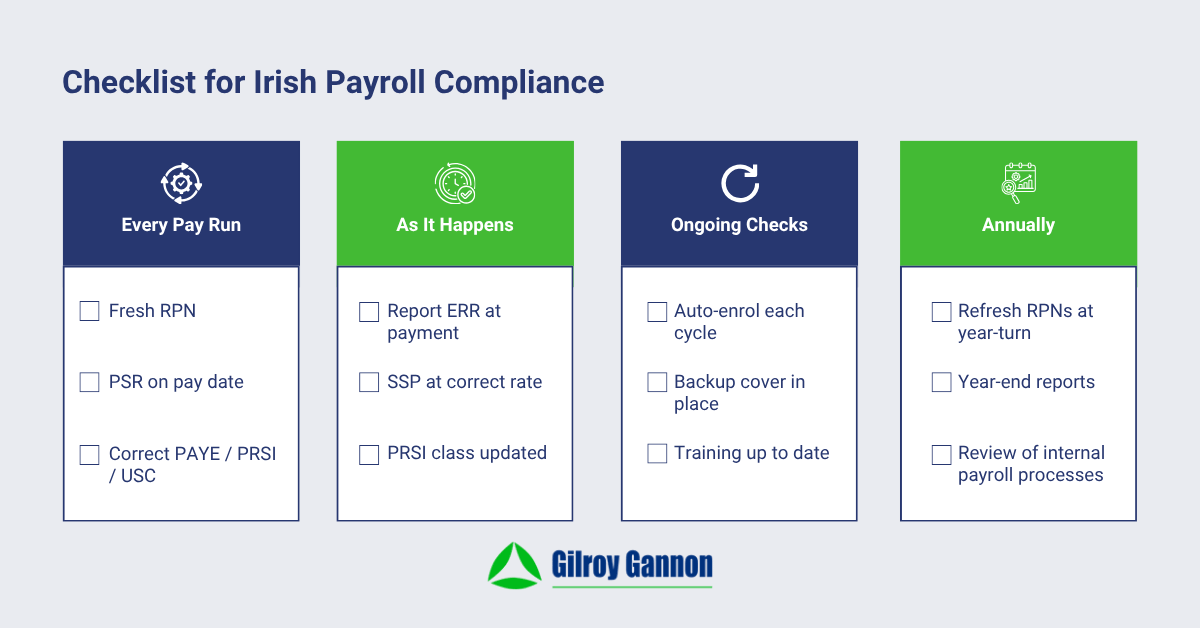
- Failing to submit PSR on or before the pay date.
- RPNs going stale, especially at the two main trigger points that commonly occur each year. The first is the January year-turn, where it is necessary to pull new, up-to-date RPNs for each employee. The second is mid-year changes when individual employees’ circumstances change.
- PRSI class misclassifications.
- Incomplete or late ERR filings
Here’s an example using PRSI classes. Classifying a director’s salary as Class A instead of Class S will result in an underpayment to the Social Insurance Fund. This can potentially go unnoticed for months. Once identified, the Revenue will recover the underpayment with interest charged at 0.0219% per day.
WRC
Penalties from the WRC in relation to employee statutory entitlements can take several different forms, including fixed penalty notices (typically as a result of an inspection) and compensation (usually following an employee complaint).
An example is getting statutory sick pay (SSP) wrong, leading to an employee lodging a complaint with the WRC. That employee can get awarded the shortfall in SSP as well as a compensation award. Compensation awards of €1,000 are not uncommon.
Infographic: Irish Payroll Compliance Calendar
The Real Benefits of Outsourcing Payroll
In the real world of running an Irish SME, the benefits of outsourcing payroll come under five main headings:
- Compliance and risk transfer
- Time and focus
- Scalability
- Confidentiality
- Continuity
We’ll now explore each in more detail.
Compliance and Risk Transfer
Compliance and risk transfer are arguably the most compelling reasons for outsourcing payroll as an Irish SME. That said, this is a benefit of payroll outsourcing that is too often oversold. Here’s the reality:
- Outsourcing payroll shifts the day-to-day risk of error to the provider. When payroll is outsourced, it becomes the provider’s job to stay up to date with current and upcoming legislation. It’s also the provider’s responsibility to ensure payroll runs, submissions, and filings are on time, accurate, complete, and compliant with current rules.
- Even with all the previous points, the legal liability for compliance stays with you as the employer.
In other words, compliance tasks and a proportion of the risks involved are transferred to your outsourced provider, but ultimate responsibility for compliance remains with you.
Time and Focus
Time and focus apply in all situations, but it is particularly important if running payroll is the responsibility of the business owner or a senior employee. Both, especially the owner, will have tasks and responsibilities that will add considerably more value to the business compared with running payroll. Their time would be better spent on those tasks and responsibilities.
Scalability
A business that is growing also has growing payroll requirements and complexities. It’s not just an increase in headcount, either, as there can be differences in employee types (part-time, full-time, seasonal), pay frequencies, and pay scales. When payroll is in-house, additional time has to be allocated to deal with those additional requirements and complexities. This can put existing resources under added pressure (with an increased risk of making errors) and/or result in the need to build additional internal payroll processing capacity.
Outsourcing payroll simplifies the scalability issue as scaling becomes the responsibility of your provider. Furthermore, good quality payroll providers will have the ability to react quickly and seamlessly to your current needs.
Confidentiality
Irish SMEs are comprised of, by definition, small (and medium-sized) teams. That can create confidentiality issues, especially if the person responsible for payroll is also handling related tasks, such as HR. Put simply, that person will know the salary and personal details of every individual within the small team.
Outsourcing payroll completely resolves this issue.
Continuity
As mentioned previously, it is common for SMEs in Ireland to have one person who is responsible for running payroll each month and keeping all the submissions and filings up to date. The simplicity of this approach can have some benefits, but it also creates a single point of failure in your business that can have significant consequences.
What happens, for example, if the person responsible for running payroll falls sick? The pay run can be delayed, a situation which is an operational risk more than a simple inconvenience. Additional impacts that can occur if the single point of failure fails include the pay run being incorrect as well as an increased risk of non-compliance with Revenue and WRC regulations.
Similar to scalability and confidentiality, outsourcing payroll completely solves this issue.
Outsourcing Payroll Decision Tool
Should you outsource your payroll?
Answer nine quick questions about how payroll currently runs in your business. This isn't a formal assessment. Instead, the tool represents the signals we see most often with Irish SMEs.
What Outsourced Payroll Includes
Outsourced payroll services can vary significantly between providers and the packages/solutions they offer. Therefore, it is important to understand what should be included and might be included, i.e., the must-have services and the nice-to-have services. Understanding this will help you more effectively and accurately compare proposals.
As a starting point, it is helpful to trace the services offered by an outsourced payroll provider to current challenges and failures. This includes operational challenges, but compliance failure points are often the most pressing, e.g., meeting PSR submission requirements, RPN management, getting PRSI classification right, etc.
The table below outlines the main services provided by outsource payroll providers.
Outsource Payroll Services Summary
| Category | What's typically included |
|---|---|
| Core processing |
|
| Revenue compliance |
|
| Statutory obligations |
|
| Auto-enrolment |
|
| Year-end |
|
| Support |
|
| Data and security |
|
This is a general guide to what a comprehensive outsourced payroll service typically covers. Scope varies by provider, so it's worth confirming exactly what's included, and what isn't, before signing up.
The Challenges of Outsourcing Payroll and How to Vet a Provider
Most of the content and information you will find about outsourcing payroll is all upside, a world of sunshine and rainbows. But in the real world of running an SME in Ireland, challenges and friction points can develop.
In this section, we highlight the most common challenges and friction points as well as what to check for when assessing outsourced payroll providers. We also provide tips on how to mitigate these challenges and friction points.
Handover Friction and Communication Challenges
- The challenge: the first few pay cycles after switching can carry risks such as data migration, unfamiliarity with the specifics of your business, and other teething problems.
- What to check for: check how the provider handles onboarding, the transition timeline, and whether you have access to a named contact during the switch.
- Mitigation advice: run the first cycle or two in parallel with the outgoing process (your in-house payroll process). With this approach, issues can be identified and resolved before anyone’s pay depends solely on the new setup. It is also recommended to agree on a transition plan and timeline in writing.
Internal Visibility Challenges
- The challenge: outsourcing can make payroll processes less clear to employees. For example, if something looks wrong on a payslip, staff may not know who to ask to get it resolved.
- What to check for: check that you will be provided with a named contact or account manager. This is preferable to a call centre-type operation.
- Mitigation advice: confirm the response time commitments detailed in the service agreement. It’s also helpful to keep one internal person (even if they no longer run payroll) as the designated liaison with the outsourced team. This creates a clear internal process for payroll queries.
Data Security Challenges
- The challenge: when you outsource, your company’s payroll data will be held externally.
- What to check for: check for robust security processes at the outsourced provider as well as GDPR compliance, the location of their data hosting, and any relevant security certifications.
- Mitigation advice: get the data processing agreement in writing and confirm in the contract who is liable, and how, in the event of a breach.
Hidden Cost Challenges
- The challenge: pricing structures can hide surprises with some outsource payroll providers. Examples include per-leaver fees, off-cycle run charges, and year-end add-ons.
- What to check for: get a fully itemised quote and ask directly for details on what is excluded.
- Mitigation advice: it is useful to get pricing examples based on your current headcount and pay frequency. Make sure you also get the full fee schedule in writing before signing up.
Provider Dependency Challenges
- The challenge: outsourcing payroll means you no longer have a single point of failure within your organisation. However, it is also important to avoid the risk of becoming too dependent on one external relationship.
- What to check for: make sure the employees at the outsourced payroll provider are properly accredited. It is also beneficial for the provider to have an established track record working with Irish SMEs as well as a ROS (Revenue Online Service) payroll agent link.
- Mitigation advice: check what continuity the provider itself has to ensure payroll for your company doesn’t rely on a single person. It is also beneficial to find out what happens to your data and records if the relationship ends. This will help in the future if you decide to switch providers.
Outsourced Payroll FAQs
Yes. Legal responsibility for payroll compliance stays with the employer even when day-to-day processing is outsourced. An outsourced provider reduces the risk of errors, and it handles the administrative burden. However, Revenue and the Workplace Relations Commission (WRC) hold the employer accountable for the accuracy of PAYE, PRSI, USC, and statutory entitlements. This is why choosing an experienced and accredited provider matters.
Yes, most Irish payroll providers can integrate with (or import data from) common accounting and payroll platforms, including Xero, Sage, and BrightPay. This means switching to an outsourced service doesn’t usually require changing accounting software. That said, it is worth confirming the integration specifics with your preferred provider before switching.
Switching to an outsourced payroll provider typically takes one to two pay cycles. Timelines are impacted by the complexity of payroll processes and how much historical data needs to be migrated. The transition usually involves the new provider collecting employee data, setting up statutory deductions, and confirming the first live pay run before fully taking over. Running the first cycle in parallel with the existing process is a common way to catch discrepancies early.
If your outsourced payroll provider is linked as your agent on ROS, they can handle correspondence and respond directly to the Revenue during an audit. This can involve, for example, accessing the payroll records and submission history they hold.
A WRC inspection or complaint works differently as it concerns employment law entitlements such as sick pay or minimum wage. An outsourced payroll provider can often supply the relevant records, but formal representation at a WRC hearing typically falls outside a payroll provider’s role.
In both cases, legal responsibility for compliance still rests with the employer. This is a crucial reason for choosing a properly agent-linked and accredited provider.
A small business should consider outsourcing payroll when payroll starts taking up significant owner or staff time each pay run. Outsourcing is also recommended when only one person understands how payroll is run, or when there’s uncertainty around rules like PRSI classification, Enhanced Reporting Requirements, or Statutory Sick Pay.
Growing headcount, increasing pay complexity, and reliance on manual processes rather than compliant software are also common triggers. These signals tend to compound, so regularly reviewing your payroll setup is the best approach even if outsourcing isn’t currently needed.
Talk to Us About Outsourced Payroll
Running payroll in-house isn’t a mistake. In fact, it is quite common. But as headcount grows, pay structures get more complex, and compliance requirements change, the real cost of “doing it yourself” starts to show up quietly.
Gilroy Gannon’s payroll team manages the full process for Irish SMEs, from payslips and Revenue submissions through to year-end reporting and compliance support. With us managing your payroll, you and your team can focus more of your time on running and growing the business.
If payroll is starting to take up more time than it should, or you’re simply not sure whether your current setup is right, get in touch for a conversation about what outsourcing could look like for your business.
Latest Blog
Check out our blog and you will get the latest news, events, and financial tips from Gilroy Gannon.

A LEO grant stalls, a VAT deadline gets missed, your…

Attracting and retaining the best talent can be challenging for…

“What's my business actually worth?” This is a question asked…

The fundamentals of statutory audits in Ireland are broadly the…

For some companies in the hospitality sector, as well as…

Agricultural Relief is about facilitating the succession of farm businesses…
Postponed VAT accounting helps Irish businesses improve cash flow by…