

5 Signs Your Business Has Outgrown Your Current Bookkeeping Process


A LEO grant stalls, a VAT deadline gets missed, your bank asks a question that nobody has a ready answer for – these are often the moments when business owners realise their bookkeeping processes are no longer suitable.
Getting to the sorts of scenarios outlined above means your bookkeeping processes are already negatively impacting your business. In this blog, we are going to highlight five early indicators that your current bookkeeping processes are not keeping pace with the growth of your business.
1. You Crossed a VAT Threshold Without Noticing
Most business owners know the VAT thresholds that apply to their company, e.g., €42,500 for services and €85,000 for goods. What catches many out, however, is that the threshold test is based on a rolling 12-month period, not a calendar or financial year. This means that a strong Christmas period, for example, or securing a big contract, could push you over the threshold.
Crossing the threshold is not the issue. Not noticing that you have crossed it is where problems arise. Modern and optimised bookkeeping processes will not only alert you that you have crossed the VAT threshold, but will help you better anticipate when that is likely to happen.
2. You Can’t Produce Management Accounts at Short Notice
There are a number of situations that can arise in business where you need to produce management accounts at short notice. Applying for a Local Enterprise Office (LEO) grant or Enterprise Ireland innovation voucher are examples. You might also need management accounts as part of a bank facility review.
In these types of situations, there is a distinction between “produce” and “prepare”. If you have outgrown your bookkeeping processes, you will be able to prepare management accounts but are unlikely to be able to immediately produce them. With the right bookkeeping processes in place, however, you will have the figures you need when you need them.
3. Bank Transactions Are Still Being Keyed in by Hand
Keying in figures by hand is no longer necessary. The same applies to manual bank reconciliations. This is because AIB, Bank of Ireland, PTSB, and all other banks operating in Ireland support live feeds into accounting software applications. As a result, manual entry is a legacy habit that is a strong (and often the most obvious) indicator that your bookkeeping processes are not as efficient and optimised as they should be.
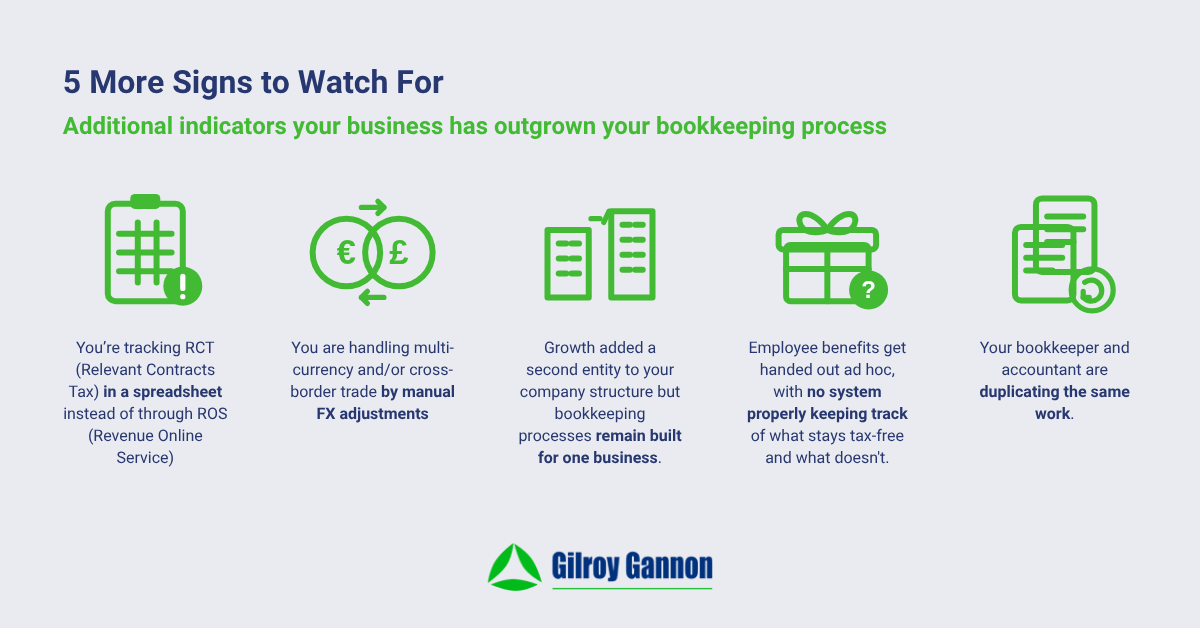
4. CRO Annual Return and iXBRL Filing is a Regular Scramble
This is one that many business owners will be familiar with – the scramble to ensure your annual returns and filings are done on time.
Unsuitable bookkeeping processes mean more work for you, your team, and your accountant, as well as increased risk of a late filing. For example, unsuitable bookkeeping processes could mean your accountant gets your records later than expected and potentially in an incomplete state. This means chasing missing records and cleaning up the accounts before the compliance work can even start.
Too often this sort of situation is framed as the CRO deadline. But the deadline isn’t the cause of the problem. With good bookkeeping processes, you will be in a position every year to hand your accountant structured and clean records, eliminating the annual scramble.
5. You Find Out About a Cash Shortfall the Week It Happens, Not the Month Before
This is a specific example of a wider bookkeeping issue that is a good indicator that your business has outgrown its current processes. It’s the difference between bookkeeping processes that record what has already happened and processes that do that but also support forecasting about what is likely to happen.
Taking the cash shortfall example, it could be related to payroll, your bi-monthly VAT payment, or preliminary corporation tax. Good bookkeeping processes will highlight in advance if you are going to be short, so there are no surprises.
Bookkeeping that Keeps Pace with Your Business
Bookkeeping is an essential part of ensuring your business runs smoothly. But it’s important that your processes keep pace with the growth of your business to ensure the necessary, albeit humdrum, task of bookkeeping doesn’t slow you down, cost you money, or get you into compliance difficulties.
We’re here to help at Gilroy Gannon, including assessing your current bookkeeping processes and giving you advice on areas for improvement. Get in touch to find out more.
Why KEEP is a Powerful Recruitment and Retention Tool
There are a number of reasons key resources would prefer to work for a rapidly scaling SME rather than a multinational. However, the numbers are too difficult to ignore, so the bigger salary often wins the day.
KEEP can help you level the playing field without having to overstretch on salary.
Plus, the 12-month minimum holding period helps with retention.
Overall, KEEP helps align critical resources with the company’s long-term plans for growth and/or a lucrative exit. Those resources will have an even greater incentive to help maximise the value of the company as they directly benefit.
Getting it Right
Best practices to help you optimise the potential of KEEP for your company include:
- Make sure the share valuation is documented and can be defended. It must be the current market value of the company at the time the share option is granted to the employee.
- Ensure that annual KEEP returns are made to the Revenue. The annual deadline is 31 March.
- The scheme you implement must be for bona fide commercial purposes as intended by KEEP, i.e., to help you recruit and retain the best talent.
- Set the scheme up properly from the outset rather than trying to fix it later.
Support from Gilroy Gannon
At Gilroy Gannon, we can help with the points above, including properly valuing your company, managing annual filings, and setting up the scheme. We can also provide advice on whether this is a worthwhile scheme to implement in your company. To learn more, get in touch to arrange a free consultation.
Latest Blog
Check out our blog and you will get the latest news, events, and financial tips from Gilroy Gannon.
In Irish SMEs, payroll is often viewed as an administrative…

A LEO grant stalls, a VAT deadline gets missed, your…

Attracting and retaining the best talent can be challenging for…

“What's my business actually worth?” This is a question asked…
The fundamentals of statutory audits in Ireland are broadly the…

For some companies in the hospitality sector, as well as…

Agricultural Relief is about facilitating the succession of farm businesses…
Postponed VAT accounting helps Irish businesses improve cash flow by…