

Attracting Talent with KEEP: How the Extended Share Option Scheme Benefits Your Scale-up


Attracting and retaining the best talent can be challenging for SMEs. This especially applies if you are rapidly scaling and need the right resources and skills to achieve your full potential.
Can you really compete with multinationals on salary? Probably not.
But you might be able to compete for talent in an area where multinationals can’t – meaningful equity.
That’s where KEEP comes in, and it’s just been extended to the end of 2028.
What is KEEP and Why Should Scale-Up Companies Care?
KEEP (Key Employee Engagement Programme) is a share option scheme for SMEs. Its purpose is as described, i.e., to help SMEs keep key employees engaged with the company.
Here’s how it works:
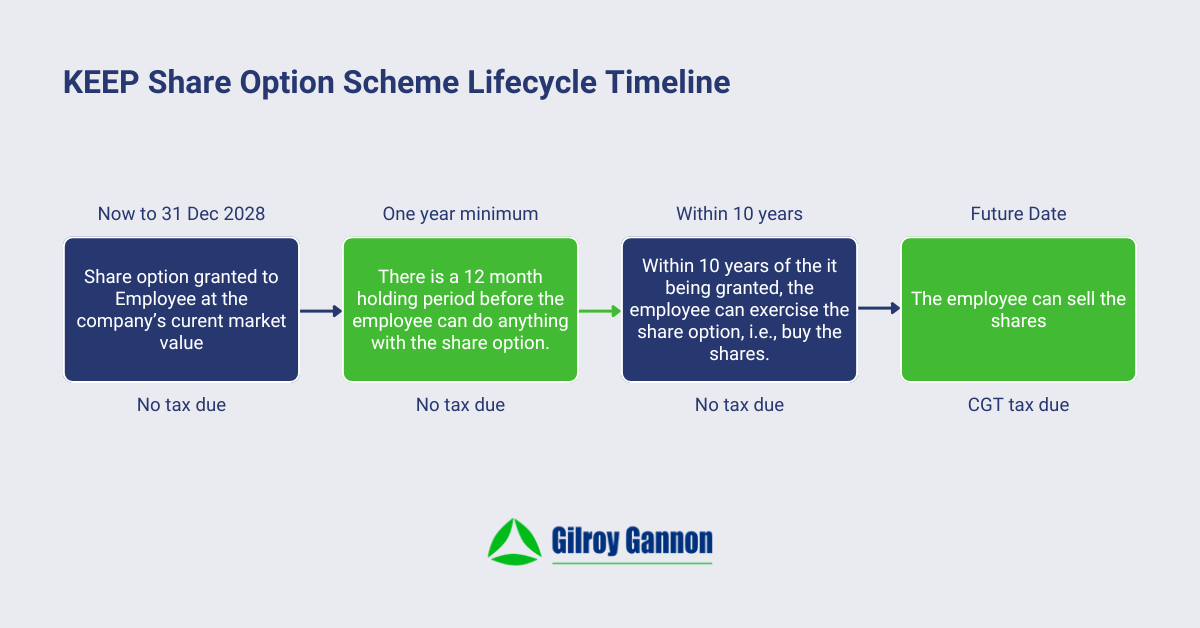
- You give key employees the option to purchase shares in the company at a fixed price at some point in the future.
- Employees have 10 years to exercise the option to purchase the shares. The idea is that the shares will be worth more than the fixed price the employee has to pay.
- The benefit of KEEP is that the employee doesn’t have to pay income tax, USC, or PRSI on the gains made when they purchase the shares.
- Provided all the criteria are met, the only tax the employee will have to pay is CGT when they eventually sell the shares.
The Tax Difference, In Numbers
In this example, an SME that is in a rapid scaling phase of growth offers a new recruit the option to purchase 10,000 shares at the company’s current market value of €2 per share.
Three years later, the company has grown and is now worth €5 per share. At this point, the employee decides to exercise her share option, buying 10,000 shares at €2 per share. The table below outlines how this plays out and how the employee benefits:
| Without KEEP | With KEEP | |
|---|---|---|
| 2026 – Share option granted (10,000 shares at €2 per share) | No tax due | No tax due |
| 2029 – Employee exercises the share option (the shares are now €5 per share, representing a gain of €30,000) | Income tax, USC, & PRSI due within 30 days (approximately €15,600) | No tax due |
| 2031 – Employee sells her shares (the shares are now €8 = €80,000) | CGT (33%) on the gain since the share option was exercised (€30,000) = approx. €9,900 | CGT (33%) on the full gain since the share option was granted (€60,000) = approx.€19,800 |
| Total tax paid | Approx. €25,500 | Approx. €19,800 |
| Tax saving with KEEP | Approx. €5,700 |
The total amount of tax saved is an important part of the scheme. Arguably just as important, however, is the timing. Without the KEEP scheme in place, the employee would have to pay a tax bill of more than €15k within 30 days of taking up the option to purchase the shares. With KEEP, no tax is due at this point in the process.
More Headroom and Flexibility
KEEP was originally due to expire at the end of 2025 but has now been extended to 31 December 2028. Other improvements from the original scheme also make it more useful and beneficial for companies in (or approaching) a rapid scaling phase:
- The cap on issued share options is now €6m (up from €3m).
- Existing shares can be used (previously, KEEP only applied to newly issued shares).
The Key Conditions and Who Can Benefit
Below are the main conditions for KEEP and who can benefit. Full information is available on the Revenue’s website.
Employee conditions:
- Both company employees and directors can benefit from KEEP.
- Must work a minimum of 20 hours a week at the company or spend 75 percent of their working time working for the company.
- Own no more than 15 percent of the company.
- Must hold the options for 12 months before exercising.
Company conditions:
- Must qualify as an SME.
- Must be based in Ireland, an EEA country, or the UK.
- Must not be listed on a stock exchange.
- Must not be in one of the handful of excluded sectors (such as financial services)
Option conditions:
- Share options must be offered at market value.
- A written agreement must be put in place.
- Individual limits for granting share options are €100k per year, €300k lifetime, or 100 percent of salary.
- The share options must be exercised within 10 years.
Why KEEP is a Powerful Recruitment and Retention Tool
There are a number of reasons key resources would prefer to work for a rapidly scaling SME rather than a multinational. However, the numbers are too difficult to ignore, so the bigger salary often wins the day.
KEEP can help you level the playing field without having to overstretch on salary.
Plus, the 12-month minimum holding period helps with retention.
Overall, KEEP helps align critical resources with the company’s long-term plans for growth and/or a lucrative exit. Those resources will have an even greater incentive to help maximise the value of the company as they directly benefit.
Getting it Right
Best practices to help you optimise the potential of KEEP for your company include:
- Make sure the share valuation is documented and can be defended. It must be the current market value of the company at the time the share option is granted to the employee.
- Ensure that annual KEEP returns are made to the Revenue. The annual deadline is 31 March.
- The scheme you implement must be for bona fide commercial purposes as intended by KEEP, i.e., to help you recruit and retain the best talent.
- Set the scheme up properly from the outset rather than trying to fix it later.
Support from Gilroy Gannon
At Gilroy Gannon, we can help with the points above, including properly valuing your company, managing annual filings, and setting up the scheme. We can also provide advice on whether this is a worthwhile scheme to implement in your company. To learn more, get in touch to arrange a free consultation.
Latest Blog
Check out our blog and you will get the latest news, events, and financial tips from Gilroy Gannon.
In Irish SMEs, payroll is often viewed as an administrative…
A LEO grant stalls, a VAT deadline gets missed, your…

Attracting and retaining the best talent can be challenging for…
“What's my business actually worth?” This is a question asked…
The fundamentals of statutory audits in Ireland are broadly the…

For some companies in the hospitality sector, as well as…

Agricultural Relief is about facilitating the succession of farm businesses…
Postponed VAT accounting helps Irish businesses improve cash flow by…