

Audit Readiness in the Age of AI: How Digital Records Streamline Your Statutory Audit

The fundamentals of statutory audits in Ireland are broadly the same today as they were 20 years ago. But loads of things around statutory audits have changed. There is now greater complexity in business, events move at a much faster pace, and technologies are everywhere.
Technologies are also ever evolving, both for good (e-commerce, accounting platforms, etc) and bad (cyber threats and online fraud). Today, the biggest changes in technology are being driven by AI – artificial intelligence. In terms of audit readiness, we are in the age of AI.
What does this mean? It’s a choice, really, between continuing as before (working hard to reactively tidy up records ahead of an audit) or modernising (maintaining clean records as a by-product of standard day-to-day operations).
In this blog, we will look at how AI-assisted tools are reshaping how records are created and maintained, thereby streamlining statutory audit processes. This benefits all businesses, especially those above the audit exemption threshold, where audit readiness is best achieved as a continuous active status.
What Auditors are Actually Looking For
Auditors are looking for evidence – sufficient appropriate evidence. The aim is for the evidence to show that your financial statements are true and give a fair view of the position of the business.
So, what is sufficient appropriate evidence? There are three main things that auditors are concerned with:
- Completeness – is everything recorded?
- Accuracy – do the numbers in the accounts match the records?
- Traceability – can everything be traced back to a source document?
It’s worth pointing out that auditors are not looking for perfection, and gaps do not prove wrongdoing. However, gaps do slow down the audit and raise the risk profile, especially when there are inconsistencies and/or a weak evidence trail.
Where Paper and Manual Processes Create Problems
Auditors are looking for evidence of completeness, accuracy, and traceability.
The problem is that paper-based and manual records are fragile and difficult to manage. Inconsistencies creep in over time. Documents are misplaced. Mistakes are made.
It’s not about dishonesty or carelessness, but the problems exist and are often not uncovered until an auditor asks a question.
The main friction points in paper-based and manual processes include:
- Document retrieval, i.e., finding documents from months ago.
- Reconciliation gaps.
- Version control, especially when spreadsheets are used.
- VAT and payroll records, especially those from months ago, where specific details can be forgotten.
Often, it’s not that paper-based or manual records are wrong. The difficult and time-consuming part during a statutory audit is proving they are right.
How AI-Assisted Accounting Tools Are Changing the Picture
Modern cloud accounting platforms such as Xero, QuickBooks, and Sage have long had features that digitise parts of the process to ensure audit readiness. Now those platforms also offer AI-assisted features that take this a stage further by automating work that typically creates the most inconsistency. Here are some examples:
- Automatic bank feeds, where transactions are imported in real-time.
- Automatic categorisation of entries to eliminate record-keeping variations.
- Flagging of unusual transactions in real-time so they can be investigated.
- Attaching documents such as invoices and receipts directly to transaction records.
What Audit-Ready Should Look Like in Practice
By themselves, the above examples from cloud accounting platforms are not ground-breaking features. But they do change the picture in terms of audit readiness:
- Traditional approach – conduct work in the weeks before an audit to get as ready as possible before the auditor arrives.
- Modern approach – audit-readiness is a continuous state.
So, instead of it taking hours to answer a query from an auditor, the answer is immediately available.
One thing is important to note, however. The technologies are excellent, and a lot of previous issues can be resolved through automation. But good accounting and bookkeeping habits still matter.
Where Your Accountant Still Adds the Most Value
It’s also worth highlighting that while AI tools are great, they do have limitations. What they are excellent at is processing and organising data. What they are not so good at is interpreting what the data means in the real-world of running a business in Ireland. They also don’t know how to exercise the type of judgement that is required during a statutory audit.
In this age of AI, there are areas where an accountant’s role remains essential:
- Interpretation – understanding what the numbers really mean.
- Risk flagging – identifying areas that could attract greater scrutiny.
- Auditor liaison – representing the business and responding to queries.
- Judgement calls – in areas such as provisions, accruals, and asset valuations.
Good digital records plus a well-informed accountant are the main ingredients for getting through audits as efficiently as possible.
Getting Audit-Ready Before Your Auditor Arrives
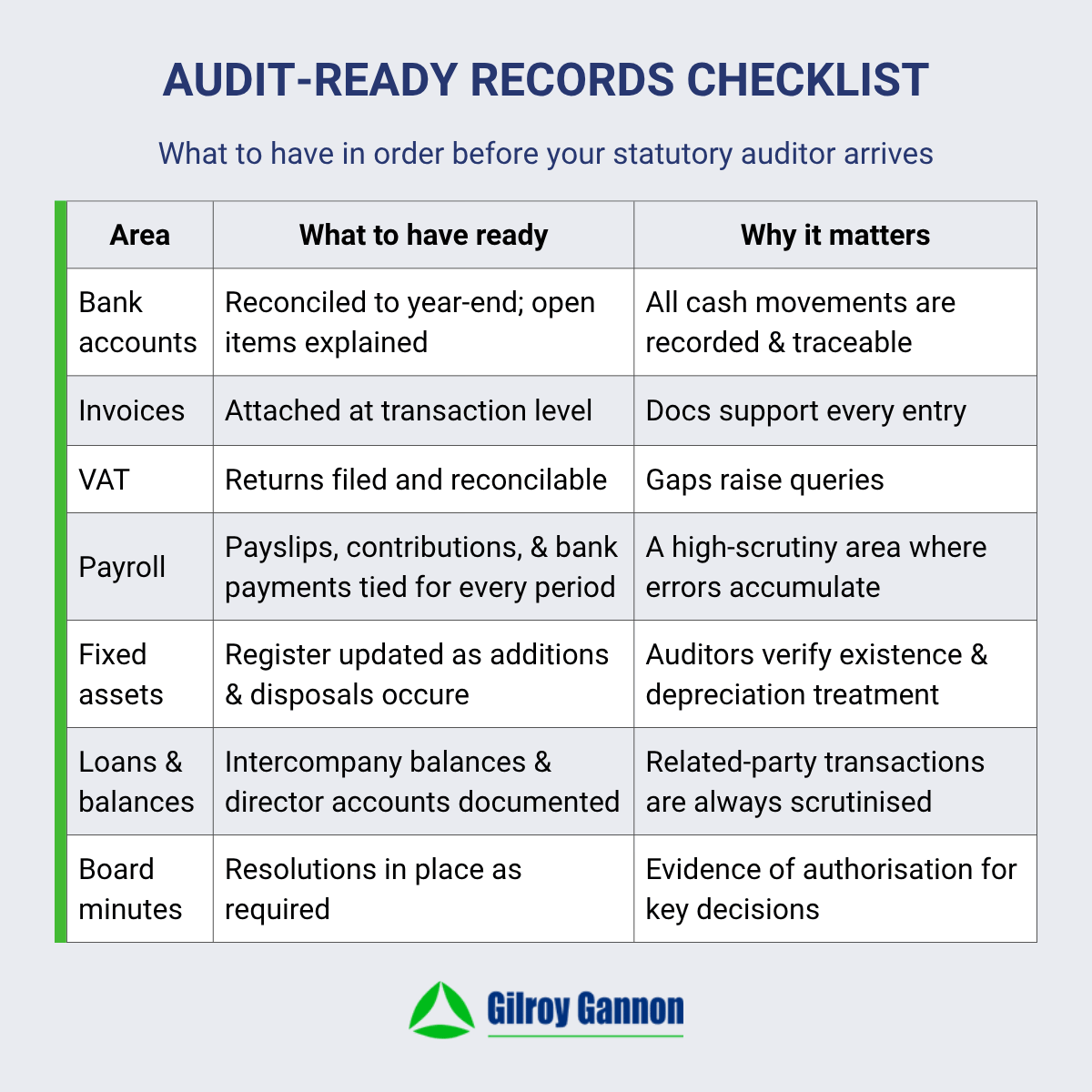
Well-maintained digital records will make the audit process much more efficient, but it is still worthwhile to conduct a short review about six weeks before your audit date. Specific things to check include:
- Bank accounts reconciled to your year-end date, with any open items cleared or noted.
- All invoices and receipts are attached to their corresponding transactions.
- VAT returns filed and reconcilable back to the accounts.
- Payroll records are complete for every pay period in the year.
- Fixed asset register updated for any additions or disposals.
- Any loans, director’s accounts, or intercompany balances are documented and explained.
- Board minutes or shareholder resolutions available if required.
The whole process, from the ongoing (and automated) maintenance of digital records to the expertise of an accountant to conducting a pre-audit review, is about optimising the audit process as much as possible. When your auditor spends their time on the substantive review part of the process rather than chasing documentation, the audit will be quicker, less resource-consuming, and, typically, less costly.
If your statutory audit is coming up and you want to make sure your records are in order, our audit and assurance team is happy to help. Get in touch with Gilroy Gannon today.
Latest Blog
Check out our blog and you will get the latest news, events, and financial tips from Gilroy Gannon.

A LEO grant stalls, a VAT deadline gets missed, your…

Attracting and retaining the best talent can be challenging for…
“What's my business actually worth?” This is a question asked…
The fundamentals of statutory audits in Ireland are broadly the…
For some companies in the hospitality sector, as well as…

Agricultural Relief is about facilitating the succession of farm businesses…
Postponed VAT accounting helps Irish businesses improve cash flow by…