

What is Postponed VAT Accounting and How Does it Work

Postponed VAT accounting helps Irish businesses improve cash flow by avoiding paying VAT upfront when importing goods from countries outside the EU, including Great Britain.
The process involves accounting for the VAT on imported goods on VAT returns rather than paying it upfront at the point of importation. It means you can simultaneously declare and reclaim VAT on imported goods, essentially making it a neutral transaction.
In this blog, we’ll look at why postponed VAT accounting is important for Irish businesses as well as the key parts of the rules you should be aware of.
Why is Postponed VAT Accounting Beneficial for Irish Businesses?
Firstly, postponed VAT accounting is only beneficial for Irish businesses that import goods from Great Britain and other countries outside the EU. The more you import, the more you are likely to benefit.
The traditional approach when importing goods that are subject to VAT is that you would pay the VAT at the point of entry into Ireland. You then reclaim that on a subsequent VAT return. However, the time between importing the goods and reclaiming the VAT can put strain on cash flow.
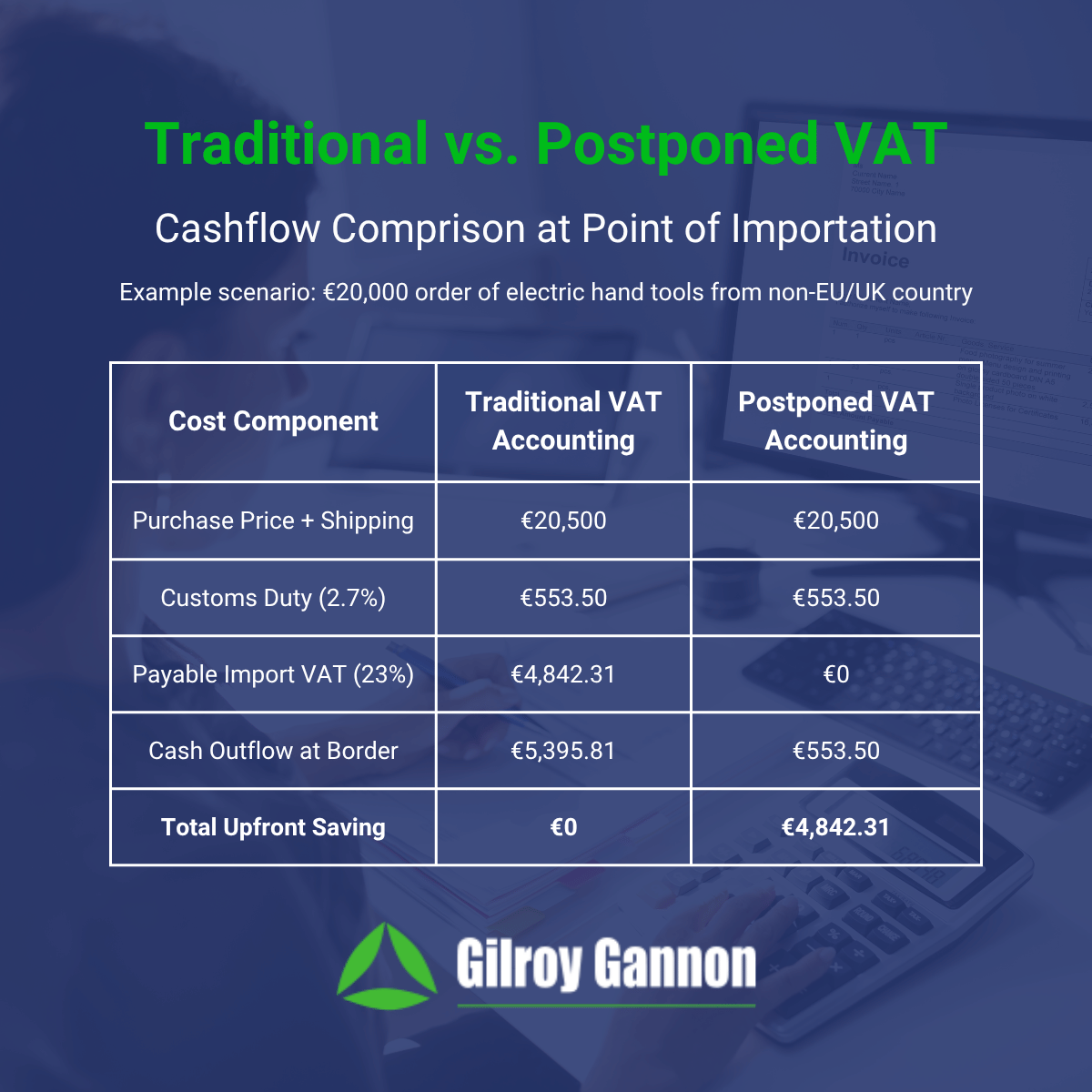
Postponed VAT accounting aids cash flow, as you don’t need to pay VAT immediately when the goods you import arrive in Ireland. Accounting for VAT on imported goods becomes largely an administrative function.
It is particularly beneficial for businesses that import a lot of goods from Great Britain. After the UK left the EU as a result of Brexit, Irish businesses in this situation faced the prospect of having to pay VAT immediately on goods imported from GB. The postponed VAT rules were introduced to alleviate that burden and maintain a steady flow of goods across the Irish Sea.
What About Northern Ireland?
Postponed VAT accounting rules apply to the import of goods from Great Britain, i.e., it excludes goods coming into Ireland from Northern Ireland. This is because, under the terms of Brexit, Northern Ireland remains within the VAT regime of the EU for goods (not services).
Therefore, the trade of goods between Ireland and Northern Ireland remains the same post-Brexit as it does for the trade of goods between Ireland and any other EU member state.
Does Customs Duty Still Apply Under Postponed VAT Accounting Rules?
Postponed VAT accounting only applies to the VAT on imported goods. It includes the VAT on all landed costs, including the purchase price of the goods, as well as shipping, insurance, and customs duty. However, only the VAT element is covered. Any customs duty that is due still has to be paid upfront.
Example of Postponed VAT Accounting Aiding Cash Flow
What About VAT Rates?
While you don’t actually pay VAT at the point of importation when you use postponed VAT accounting, it is still important to use the correct VAT rate when completing the relevant forms. In most cases, the rate of VAT will be the same as the domestic VAT rate.
What Are the Criteria for Using Postponed VAT Accounting?
The two main criteria for using postponed VAT accounting are that you need to be VAT registered and also registered for Customs & Excise.
How Does the Process Work?
In summary, the intent to use Postponed Accounting is selected by using specific codes on the Customs Declaration filed by the importer of record, or their broker, at the time the goods enter the State.
Later, when you file your VAT3 Return for the applicable period, you enter the total customs value of those specific goods in the mandatory PA1 field. In most cases, T1 (the VAT on sales) and T2 (the VAT on purchases) will cancel each other out, resulting in a neutral cashflow impact.
Postponed VAT Accounting Advice
- Using postponed VAT accounting is an optional measure introduced to alleviate cash flow. If you choose not to use it, you may pay import VAT upfront at the time of importation and account for it normally on your VAT return or use a deferred payment system if you are authorised to do so.
- Make sure you keep good records to help with reconciliation, and if there are any queries.
- Make sure you regularly reconcile your monthly statement from the Revenue.
Support from Gilroy Gannon
Postponed VAT accounting is great for cash flow, but it still requires close administration to ensure compliance. At Gilroy Gannon, we can help with all your VAT requirements, including postponed VAT accounting, as well as other tax and related business needs. Get in touch to arrange a consultation.
Latest Blog
Check out our blog and you will get the latest news, events, and financial tips from Gilroy Gannon.
Postponed VAT accounting helps Irish businesses improve cash flow by…

Revised Entrepreneur Relief has been around since 2016, but this…

The rate of VAT on the sale of apartments has…

The government’s auto-enrolment pension saving scheme is up and running.…

From 1 January 2026, the national minimum wage in Ireland…

Whether you have a handful of employees or a rapidly…
Ireland's economy and business landscape is becoming increasingly sophisticated while…
Navigating VAT compliance in Ireland involves keeping good records, getting…